Posts

Domestic bliss | An Evening at Home (1976)

Image
  The newlyweds in March 1976 While writing and posting the first several entries of this project, I learned that Ahmed's wife, Nousa, passed away suddenly on May 16, 2024. Nousa helped guide, shape, and protect Ahmed and his legacy for most of his adult life and her sudden absence casts a shadow long enough to darken even this humble project on the other side of the world. Upon his return from London in early 1976, Ahmed Adaweya marries Wanisa Ahmed Atef, better known as Nousa. Their relationship is strained almost from the beginning, as Ahmed is often on the road, performing internationally, while Nousa, according to Ahmed Naji's " The Woman Who Devoured Adaweya ," suffered his absence so severely, her hair began to fall out. The couple would apparently soon separate, with the initial plan of divorcing, before reuniting for good in 1978. This gives Ahmed's second cassette of 1976, An Evening at Home , additional resonance, a hint of bittersweetness, if not irony...
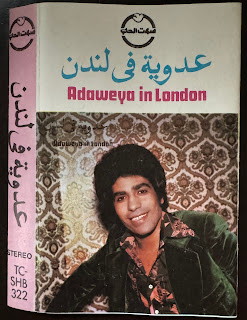
Big pimpin' | Adaweya in London (1976)

Image
  While in England's capital, Ahmed experiences one of the biggest highs and bitter lows of his early career. Ahmed's 1976 opens with a residency at the Omar Khayyam in London. London may seem like an odd choice for him to have visited that year, but according to this 1976 Guardian article by David Hirst , the city was teeming with Arab visitors and immigrants hungry for entertainment. ( A post by Asmahan of London about her 1977 visit echoes this .) The Omar Khayyam in it original building on Cannon Street. It later moved to Regent. "The Arab visitors," Hirst writes, "now almost exclusively male and wearing Western dress, are likely to head for a nightclub or a casino. If it is Crockford's to which they may have been drawn by sumptuous advertisements in Arabic magazines, they can retire to an 'Arab room' with Egyptian hostesses in attendance. If it is to the Omar Khayyam nightclub, they will find an ambience, decor, floorshow, staff, and clientele so...

Blows against the empire | But Check Out What Adaweya Is Doing (1975)

Image
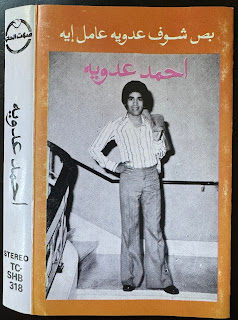
  Their applause and exhortations are so aggressive you wonder if it's not meant for Ahmed but for his haters. This feels more like a sporting event than an hour of music. Before the first track officially kicks in, there's a rousing all-woman chorus sing-cheerleading the album's title: "Bis! Shouf! Adaweya Amil 'Iyh! Bis! Shouf! Adaweya Amil 'Iyh!" The word "album" in regard to recordings dates back to the 78 RPM shellac era, when it meant literally a number of single 78s collected together in a physical album, similar to a photo album. For people of my generation in America, it meant long-playing, 12" 33-1/3 RPM vinyl records, generally, though it could also mean an implied cohesiveness or unifying concept, the live album, for instance, or the experience, for want of a better word, of Pink Floyd's  Wish You Were Here . In 1970s Egypt, most 12" LPs were simply collections of songs, many earlier released on singles; however, increas...

All the single ladies | An Evening with the Best Songs of Ahmed Adaweya (1975)

Image
  "This is history. I am a whole history. I am king of saltana" In 1975, the last year Ahmed remains a bachelor, he releases three albums: An Evening with the Best Songs of Ahmed Adaweya  (LP) and But Check Out What Adaweya Is Doing  (cassette) on Sout El Hob and An Evening with Ahmed Adaweya  (LP) on Moriphon. I don't have a copy of the Moriphon. On its Ahmed Adaweya page , belly dance website Gilded Serpent spends some time unpacking the term "saltana." It's a word Ahmed uses to describe himself and his facility with the mawwal.  "What exactly is Saltana?" Gilded Serpent contributor Amina Goodyear queries. "Nothing is exact in Egypt. The word evokes derogatory connotations of a drugged state. This is how people perceived Adaweya, whether he was awake or asleep. To get Saltana takes time—in performance, sometimes hours. If Tarab is ecstatic joy, then Saltana is the ecstasy of creation. Time passes, and you don’t feel it." Goodyear note...

The medium is the massage | Ahmed Adaweya 2 (1974 or 1975)

Image
  Adaweya's phenomenal success, despite rejection by much of the music establishment, owed almost everything to the cheapness and ubiquity of the cassette. Ahmed didn't need to be on the radio. The first cassette published in Egypt, if Discogs is our evidence, is Sono Cairo's 1971 edition of Oum Kalthoum's Ho Sahih El Hawa Ghalab, with music by Zakaria Ahmed and lyrics by Tunisian Egyptian poet Bayram al-Tunsi, both of whom had passed away in 1961. According to Virginia Danielson , Zakaria Ahmed had played a critical role in helping Kalthoum establish herself in early 1920s Cairo. Discogs lists two cassettes published the next year, 1972: A collection of songs on the Randophone label by newcomer Ahmed al-Soumbati (Riad al-Soumbati's son) and the debut collection by Afaf Rady on Soutelphan, who had launched her recording career in 1970 with the release of three singles. Discogs catalogs seven cassettes in 1973, including Warda's magnificent Khalik Hena and the Be...

Last splash | Sitt al-Hawanim (1974)

Image
  “The Sah Al-Dah singer proposes to the girl of his dreams” from the February 7, 1974, issue of Al-Mawa’id Composed by accordion player and dance-music composer Mohamed Asfour with lyrics by our old friend Hassan Abu Itman, the A side is a solid entry into the singer's early canon, but it's the mawwal on the B side that hits you in the guts. Ahmed is at his most anguished, most adamant, most pyrotechnic -- and the ensemble is absolutely on fire. A clipping posted by  Egyptian writer Ahmed Naji to his website suggests that, in early 1974, Ahmed Adaweya was engaged to marry the daughter of a kebab seller, 17-year-old Hanim Morsi. Naji notes that, other than this clipping, we never hear about her (or her father, for that matter) ever again. Ahmed himself never seems to mention her; however, he later recalls that, during his years of apprenticeship and struggle on Mohamed Ali Street, he had fallen in love with girl who lived with her parents and, in an effort to woo her int...

Everything everywhere all at once | Kolo Ala Kolo (1974)

Image
Kolo Ala Kolo cover from the Discogs site (my copy of the single is coverless)   In the way that punk made music accessible (how many accounts of singers and musicians seeing their first punk show, saying to themselves and their friends, "We could do  that, " and subsequently starting their own band have we read?), there is an accessibility to this music, an almost "colloquial" (let's call it) vibe overall. Farouk Salama and Hassan Abu Itman, who collaborated on " Salamitha Oum Hassan " (music and words, respectively) team up again to provide Ahmed with another track that will hit the charts and survive the ages, "Kolo Ala Kolo," or "Everything on Everything" ( Andrew Simon 's translation), another likely colloquialism that Google translate wants me to change to "All in All." Watch Ahmed perform both Salama/Itman tracks in this wild 1980 performance Andrew Simon: "Adawiya again engages someone who is better off th...